Amazon’s March 2026 rollout of the new "Canvas" AI experience in Seller Central marks the end of static spreadsheets. Powered by Amazon Bedrock, Amazon Nova, and Anthropic’s Claude, this agentic AI tool allows sellers to instantly visualize sales data, model complex inventory scenarios, and simulate the exact margin impact of their decisions in real time. However, while Canvas functions as an incredibly powerful digital financial advisor, its predictive models are only as effective as the physical supply chain executing them. If you blindly follow algorithmic recommendations without an agile, external logistics strategy, you risk severe FBA storage penalties and margin compression.
From Static Calculators to Digital Financial Advisors
For years, cross-border sellers have relied on clunky, retrospective reporting to piece together their true Cost of Goods Sold (COGS) and advertising impact. The Canvas experience fundamentally replaces that outdated workflow. By integrating directly with Amazon’s Seller Assistant chat, Canvas generates highly personalized, dynamic visual workspaces on the fly.
If you ask the AI, "How are my products performing?", it will instantly generate charts showing sales trends, traffic, and inventory health. The true power, however, lies in conversational scenario planning. You can seamlessly ask follow-up questions like, "What happens to my cash flow if demand for this SKU drops by 10%?" or "What is the margin impact if I restrict PPC spend strictly to excess inventory?" The Canvas interface instantly adapts, rebuilding the visual data to project your future profitability before you commit a single dollar to advertising or procurement. It is the operational difference between giving a seller a better calculator and handing them a dedicated financial advisor who knows their catalog inside and out.
The Margin Reality: Simulating Your Inventory Strategy
Where Canvas becomes a massive competitive weapon for logistics-focused sellers is in its role as a real-time decision simulator. Balancing the risk of an algorithmic penalty for a stockout against the crushing cost of FBA long-term storage fees is the most dangerous calculation a seller makes.
Rather than simply warning you that a product is running low, Canvas maps out multiple, mathematically modeled paths forward. It compares the financial outcomes of rushing an air-freight restock, delaying a Purchase Order to gauge Q3 demand, or heavily discounting the remaining units. It visually calculates the exact impact each choice will have on your storage fees, competitive positioning, and bottom-line revenue. Currently, Amazon reports that sellers accept these AI recommendations nearly 90% of the time, proving how deeply this tool is already influencing global supply chain operations.
Algorithmic Lock-In and Data Visibility
While Canvas offers enterprise-grade business intelligence for free, sellers must remain highly strategic about how they use it. The platform's algorithm is inherently designed to optimize the Amazon ecosystem, which often favors keeping maximum stock within FBA. When you utilize Canvas to model your granular growth plans, pricing experiments, and inventory thresholds, you are giving the marketplace unprecedented visibility into your operational playbook. Relying exclusively on Amazon's internal AI to manage your entire supply chain creates a dangerous dependency.
You cannot afford to ignore Canvas—your competitors are already using it to optimize their margins. However, you must pair the AI's predictive intelligence with a logistics infrastructure that operates outside of Amazon's walled garden.
Linktrans Helps You Develop an Action Plan
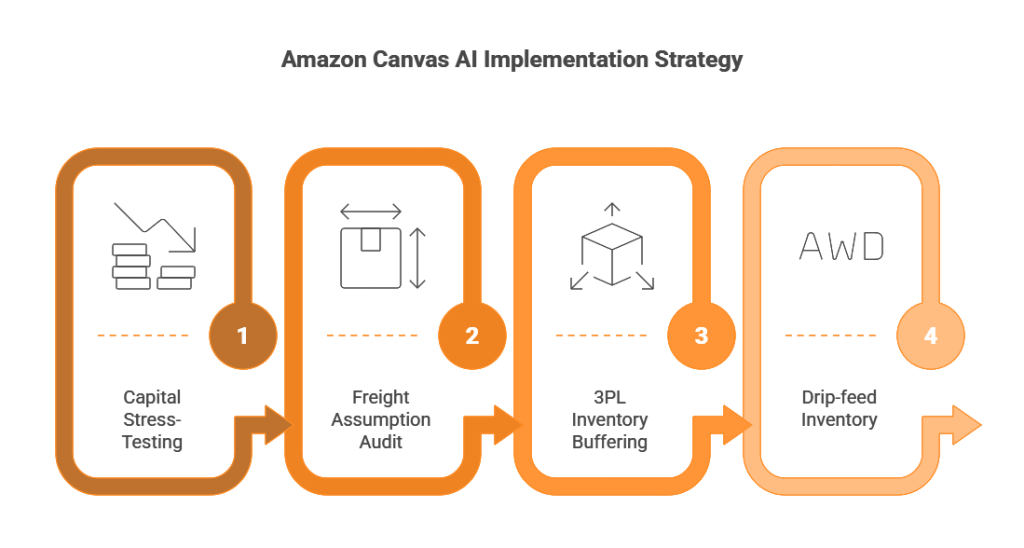
Stress-Test Your Capital with Scenario Planning: Log into Seller Central today and use Canvas to run a 30-day downside projection on your top-heavy SKUs. Ask the AI: "What is the exact FBA fee impact if sales velocity drops by 15% this month?" Use those visual projections to dictate your immediate liquidation or coupon strategies.
Audit the AI's Freight Assumptions: Canvas will recommend restock quantities based on projected demand, but its models do not account for your specific, negotiated ocean freight rates. Always cross-reference the AI's "profitable" restock recommendation with real-world quotes from your freight forwarder to ensure the math actually works.
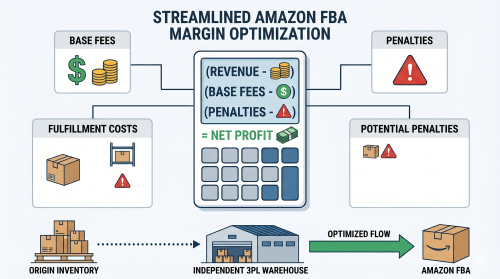
Buffer Your Inventory with a Domestic 3PL: When Canvas dictates that a hero SKU needs a massive container restock to maintain search ranking, do not send the entire volume directly to FBA. Route the bulk inventory to your Linktrans domestic warehouse and drip-feed it into Amazon AWD. This satisfies the AI's demand projections while bypassing Amazon's severe inbound placement fees.
06 Mar, 2026