Amazon remains the undisputed giant of global e-commerce, offering unparalleled top-of-funnel traffic. However, relying on a single marketplace means surrendering your pricing power, customer data, and profit margins entirely to a single algorithm.
As fulfillment costs rise and search visibility becomes fiercely competitive, multichannel expansion is no longer a luxury—it is a baseline requirement for business survival. But not every seller is equipped to manage a fragmented retail strategy. Expanding prematurely can fracture your supply chain and erode your cash flow.
This guide breaks down the three specific types of Amazon sellers who must pivot to a multichannel model, provides data-driven roadmaps for the top alternative platforms, and outlines the physical logistics required to make the transition profitable.
1. The 3 Types of Sellers Primed for Multichannel Expansion
Before auditing new platforms, you must identify your exact structural bottleneck on Amazon.
The Brand Builders (Data-Starved)
Amazon heavily restricts access to first-party customer data. If your business model relies on building long-term brand equity, launching subscription models, or driving repeat purchases through email marketing, Amazon’s masked customer profiles are actively stifling your growth. You need a platform that allows you to own the customer relationship.
The Squeezed-Margin Sellers
If your products are oversized, heavy, or have a low average order value (AOV), your margins are likely being consumed by the compounding costs of Amazon FBA storage fees, inbound placement fees, and rising PPC bidding wars. You need a platform with a more favorable fee structure to restore profitability.
The Category Dominators (Growth-Capped)
If you already hold the Best Seller Rank (BSR) in your primary category, your organic growth on Amazon has mathematically hit a ceiling. You have captured the maximum available search volume. To continue scaling revenue, you must introduce your established products to entirely new audiences on different networks.
2. The Best Amazon Alternatives: Data, Strategy, and Execution
If you fit any of the profiles above, the next step is selecting the right ecosystem. Each platform serves a distinctly different consumer intent and requires a tailored operational approach.
A. Walmart Marketplace: The High-Intent Retail Alternative
Walmart Marketplace has transitioned from a secondary option to a retail powerhouse, offering access to millions of unique monthly visitors who exhibit high purchase intent but strictly avoid Amazon.
- The Data: Recent e-commerce benchmark reports indicate that Walmart Marketplace sellers often experience a 30% to 40% lower Cost Per Click (CPC) on advertising compared to Amazon, simply due to lower vendor saturation. Furthermore, listings integrated with Walmart Fulfillment Services (WFS) routinely see a 50% conversion rate lift due to the "TwoDay" shipping badge.
- The Strategy: Walmart is strictly a product-centric catalog. It is ideal for "Category Dominators" and sellers of standardized, high-volume goods (home appliances, electronics, daily essentials).
- Case Study: A mid-sized consumer electronics brand hit a revenue plateau on Amazon. By shifting 20% of their top-performing SKUs to Walmart Marketplace and utilizing WFS, they captured a completely different demographic—suburban retail loyalists. Within six months, the brand generated an incremental 28% in gross revenue without cannibalizing a single Amazon sale.
B. Shopify (DTC): The Ultimate Engine for Brand Equity
Shopify is not a marketplace; it is infrastructure. It provides the software to build a standalone Direct-to-Consumer (DTC) ecosystem where you dictate the rules, own the domain, and capture 100% of the customer data.
- The Data: According to industry retention metrics, DTC brands that leverage first-party data for personalized email and SMS marketing achieve an average Customer Lifetime Value (LTV) that is 3.5 times higher than pure Amazon sellers. Repeat purchase rates on well-optimized Shopify stores frequently exceed 25%.
- The Strategy: Perfect for "Brand Builders." Shopify allows you to construct a highly curated, minimalist brand aesthetic. To drive traffic, brands are increasingly moving beyond traditional Facebook ads and establishing owned communities—such as building an official brand subreddit—to capture highly engaged, top-of-funnel organic traffic before routing them directly to their Shopify checkout.
- Case Study: A premium outdoor gear manufacturer struggled with Amazon's commoditization of their products. They launched a minimalist Shopify storefront and built an engaging community presence on Reddit to discuss outdoor survival tactics. By capturing email addresses directly, they launched a VIP loyalty program. Their Customer Acquisition Cost (CAC) dropped by 42% over eight months as direct, repeat purchases replaced expensive Amazon PPC campaigns.
C. TikTok Shop: The Social Commerce Accelerator
TikTok Shop has obliterated the traditional marketing funnel, collapsing awareness, consideration, and conversion into a single, 15-second video interaction.
- The Data: Social commerce is driven by impulse. Internal data reveals that the conversion rate for users who click a native TikTok Shop product link embedded in a creator's video is phenomenally high, often eclipsing 4% to 6% for low-to-mid-ticket items ($15 - $45 AOV).
- The Strategy: This channel is essential for visually engaging products (cosmetics, lifestyle gadgets, apparel). Success requires abandoning static imagery and aggressively partnering with micro-affiliates who can demonstrate the product organically.
- Case Study: A niche skincare brand was being outbid by legacy brands on Amazon search results. They pivoted to TikTok Shop, sending samples to 50 micro-influencers. A single viral tutorial video generated over 1.2 million views and processed 4,500 orders in 48 hours—a volume that would have taken three months to achieve on Amazon, with zero upfront PPC spend.
3. Upgrading Your Physical Logistics
Expanding your digital storefronts is only 10% of the battle; executing the physical fulfillment is the other 90%. A fragmented logistics network will instantly destroy the profits of a multichannel strategy.
The MCF Limitation Many sellers attempt to use Amazon Multi-Channel Fulfillment (MCF) to fulfill Shopify or Walmart orders. This is a critical error. Walmart explicitly penalizes and bans sellers who deliver goods in Amazon-branded boxes. Furthermore, MCF fulfillment fees are notoriously high, squeezing your DTC margins.
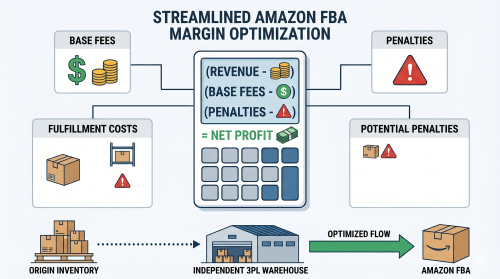
Independent 3PL and "One Inventory" Routing To scale across Walmart, Shopify, and TikTok simultaneously, you must decouple your storage from Amazon. You need a centralized third-party logistics (3PL) partner capable of housing a single pool of inventory, routing pallets to FBA and WFS as needed, and fulfilling DTC orders directly.
Protecting the Bottom Line: Inspect First, Load Later When selling off-Amazon, the cost of returns (reverse logistics) falls entirely on your balance sheet. TikTok impulse buys and high-ticket Shopify orders are highly sensitive to product defects. To protect brand equity and mitigate return losses, sellers must integrate an "Inspect First, Load Later" quality control model at the origin.
By executing rigorous, standardized inspections at the export hubs in China or Southeast Asia before the container is ever loaded, you eliminate defective units from the supply chain entirely. You stop paying ocean freight, customs duties, and 3PL storage fees for unsellable inventory, ensuring that every unit arriving in North America is pristine and ready for multichannel distribution.
Stop renting your customers. Start auditing your top-tier SKUs, select the platform that aligns with your product lifecycle, and restructure your logistics infrastructure to support true, frictionless global commerce.
02 May, 2026