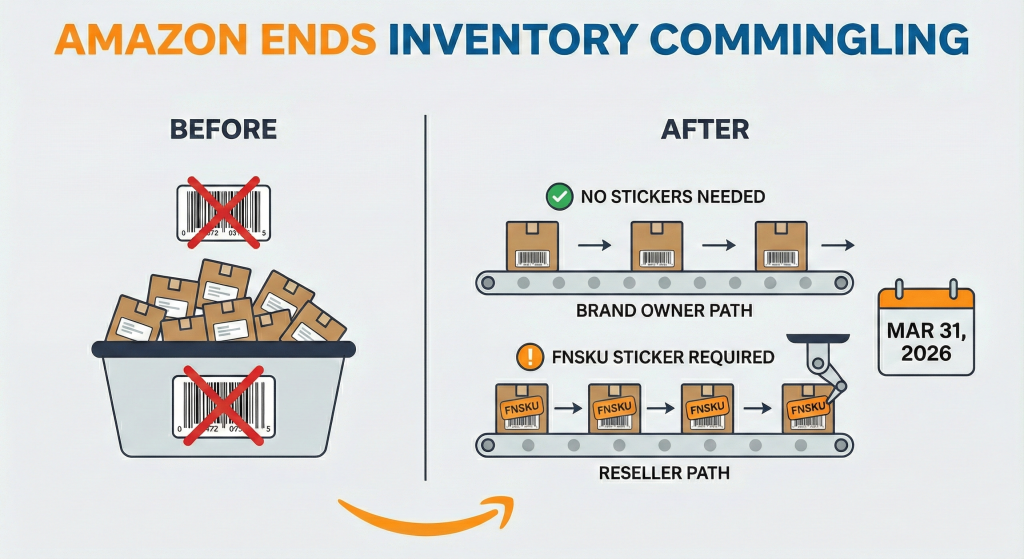
Amazon Seller Central dropped a significant policy update that will fundamentally change how inventory is managed within its fulfillment network. Effective March 31, 2026, Amazon is officially ending "commingling" practices across its entire supply chain.
For years, commingling allowed Amazon to fulfill customer orders using the closest available unit—even if that unit belonged to a different seller—to achieve faster delivery speeds. Amazon has stated that this practice is no longer necessary, as most sellers now maintain inventory levels sufficient to support fast delivery without swapping stock between accounts.
While the end of commingling promises greater control over your specific inventory, it comes with strict new labeling criteria that divide sellers into two distinct categories: Brand Owners and Resellers.
The New Rules for Brand Owners
For brand owners, this update offers a significant operational advantage. Starting March 31, 2026, sellers who are enrolled in Amazon Brand Registry with the "brand representative" selling role will no longer need to apply Amazon barcode stickers to prevent commingling.
If your products already have a valid manufacturer barcode (such as a UPC, EAN, or ISBN), you can rely solely on that barcode. Because commingling is being retired, you no longer have to worry about your "stickerless" inventory being mixed with another seller's stock. This provides greater flexibility for your supply chain, as you will not need to pre-allocate or specially label units for Amazon, making it easier to manage inventory shared between Amazon and other sales channels.
The New Mandate for Resellers
For resellers, the update introduces a new layer of mandatory prep work. If you are not enrolled in Amazon Brand Registry as a brand representative, you will now be required to use Amazon barcode stickers (FNSKU) for all products, even if those products already have a manufacturer barcode.
In the past, many resellers utilized commingled inventory (manufacturer barcode tracking) to avoid the time and cost of labeling every unit. Under the new policy, that option is disappearing. Every unit sent to FBA must carry a unique Amazon barcode sticker to ensure it is tracked specifically to your account. If you are already using FNSKU stickers, your process remains unchanged; however, if you rely on stickerless commingling, you must update your workflow before the March deadline.
It is important to note that the rule for "unbarcoded" products remains the same for everyone. For any product that does not have a manufacturer barcode (UPC/EAN/ISBN), both Brand Owners and Resellers must continue to apply Amazon barcode stickers.
This policy shift effectively separates the supply chain strategies for brands and resellers. Brand Owners gain efficiency, allowing them to ship "retail-ready" packaging directly to FBA without additional labeling. Resellers, however, must budget for the additional labor or 3PL costs required to label every single unit.
Sellers should review their current FBA settings and inventory workflows immediately. For Brand Owners, verify your role in Brand Registry to ensure you qualify for the exemption. For Resellers, begin assessing your labeling capabilities—whether that means hiring additional warehouse staff, utilizing Amazon’s FBA Label Service, or partnering with a third-party logistics provider.
11 Dec, 2025