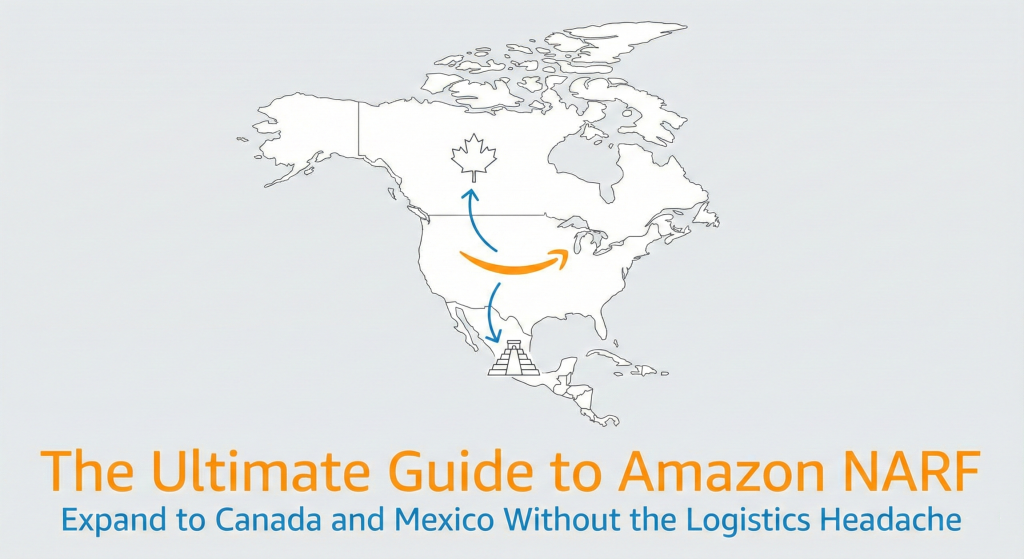
Expanding your brand into international marketplaces is widely considered one of the most effective levers for scaling an ecommerce business. The allure of reaching millions of new customers in Canada and Mexico is undeniable, yet for many sellers, this excitement is quickly dampened by the operational reality of international logistics. Navigating foreign import rules, managing cross-border returns, and dealing with split inventory pools can often feel like a full-time job in itself.
For the vast majority of U.S.-based sellers, the solution is not to build a complex international supply chain from scratch—it is to utilize Amazon’s North American Remote Fulfillment (NARF) program.
This program allows you to list your products on international marketplaces like Amazon Canada and Amazon Mexico without ever sending a single unit of inventory to those countries. By keeping your stock on U.S. soil and letting Amazon handle the borders, you can test new markets with virtually zero risk.
But is it really that simple? Can you truly switch a toggle and sell internationally without the logistics headache? In this extensive guide, we will explore the nuances of the NARF program, including the specific eligibility requirements, the hidden fee structures, the operational pros and cons, and the step-by-step process to enroll and grow your North American presence.
Part 1: What Exactly is Amazon NARF?
North American Remote Fulfillment (NARF)—now officially referred to by Amazon as Remote Fulfillment with FBA—is a logistics program designed to break down the borders between the North American marketplaces. It allows sellers to store their products in Amazon fulfillment centers located in the United States and use that same inventory to fulfill orders to customers across Canada and Mexico.
The mechanics of the program are surprisingly seamless. Once you are enrolled and your offers are created, your listings automatically become live and purchasable on Amazon.ca and Amazon.com.mx. When a customer in Toronto or Mexico City places an order, Amazon’s system routes that order to your U.S. inventory. Amazon then picks, packs, and ships the item across the border, handling the export paperwork and final delivery to the customer.
The "Global SKU" Advantage To appreciate the simplicity of NARF, one must understand the alternative. If a seller did not use NARF but wanted to sell in both Canada and Mexico, they would be forced to send separate FBA shipments to warehouses in each country. This traditional model requires managing three separate pools of inventory, paying storage fees in three different countries, and navigating three distinct customs clearance processes.
NARF eliminates this fragmentation entirely. It allows sellers to utilize a single pool of inventory for all three countries. For example, if you have 100 units of a product sitting in a fulfillment center in Texas, those 100 units are simultaneously visible and available for sale to customers in the U.S., Canada, and Mexico. Amazon uses a single “Global SKU” for your product, meaning you only need to create the listing once, and the system handles the rest.
How Duties and Taxes Work One of the most attractive features of NARF is the handling of import duties. When a sale occurs via NARF, the customer acts as the importer of record. They are responsible for paying any applicable import duties and taxes on the items they order, not the seller. Amazon collects an "Import Fees Deposit" from the customer at checkout and pays the authorities on their behalf. This means sellers do not need to file or pay taxes to Canada or Mexico directly.
Part 2: Eligibility Requirements to Enroll
Not every seller can simply toggle this feature on. Amazon maintains strict eligibility criteria to ensure that sellers can meet the demands of cross-border commerce. Before attempting to enroll, you must verify that your account meets the following four pillars of eligibility.
1. Professional Seller Account First and foremost, you must have a Professional Amazon seller account. Sellers operating on the Individual plan are strictly prohibited from enrolling in Remote Fulfillment. If you are still on an Individual plan, you will need to upgrade and pay the monthly subscription fee to access this feature.
2. North American Unified Account You must possess a North American Unified Account to participate. This account type allows you to toggle seamlessly between the U.S., Canadian, and Mexican marketplaces within a single Seller Central dashboard. Most modern accounts are unified by default, but if you have an older account, you may need to manually upgrade via the 'Upgrade to a Unified Account' page in your settings.
3. Fulfillment by Amazon (FBA) Only The program is exclusive to the FBA network. Products enrolled in NARF must be physically present in an Amazon warehouse; Merchant Fulfilled (FBM) listings are not eligible. This is because Amazon must control the shipping process to handle the complex cross-border documentation and customs clearance procedures that individual sellers cannot easily manage.
4. Trade Compliance Finally, your products must meet all trade compliance regulations for the destination country. Just as with domestic sales, Amazon restricts the sale of certain items. Dangerous goods, prohibited products, and restricted categories (such as certain food items or plants) may be blocked from the program.
Part 3: Understanding the Costs (Program Fees)
One of the most common misconceptions about NARF is that the fees are identical to domestic shipping. This is incorrect. Remote Fulfillment fees are structured differently than the FBA fees you are accustomed to, and they are generally higher to account for the complexity of international logistics.
According to Amazon's fee schedule, program fulfillment fees apply specifically to sales on Amazon.ca and Amazon.com.mx. When you sell an item to a U.S. customer, you pay the standard U.S. FBA fee. However, when that same item is sold to a customer in Mexico, you pay the specific Remote Fulfillment Fee.
A Closer Look at the Numbers: The fees vary significantly based on the size and weight of the product.
- Canada Fees: For a small standard item (6 oz or less), the fulfillment fee is approximately $7.58 CAD during non-peak periods. As the item gets heavier (1 to 2 lb), the fee rises to $11.64 CAD.
- Mexico Fees: For shipments to Mexico, a small standard item incurs a fee of roughly $122.87 MXN. Oversize items see a dramatic increase, with small oversize products starting at $270.73 MXN.
Amazon automatically adjusts your listing price in the target marketplace to account for these higher fees and the exchange rate. While this automation protects your profit margin, it means your final price to the customer will be higher than it is in the U.S., potentially impacting your competitiveness.
Part 4: Pros and Cons Analysis
Using the Amazon NARF program is a strategic decision that comes with distinct trade-offs. It is essential to weigh the benefits of simplicity against the costs of speed and pricing.
The Strategic Advantages (Pros) The most significant advantage is the ability to test new marketplaces quickly and with low risk. Launching a product internationally usually requires a massive upfront investment in inventory and shipping. With NARF, you can launch in Mexico overnight without sending a single pallet across the border.
Additionally, the logistical simplicity cannot be overstated. By keeping your inventory in a shared U.S. pool, you eliminate the headaches of managing stock levels in multiple countries. From a tax perspective, the benefit is absolute: sellers do not need to file or pay taxes to Canada or Mexico. Finally, the ease of setup—where listings are automatically translated and duplicated—makes global expansion accessible to even small teams.
The Operational Drawbacks (Cons) However, these benefits come at a cost to the customer experience. Because the customer is responsible for import duties and higher shipping fees, your product will inevitably be more expensive than a competitor’s product that is stored locally in a Mexican warehouse.
Furthermore, shipping times are significantly longer than the Prime speeds customers have come to expect. While a local order might arrive in 24 hours, NARF orders typically take 5 to 9 days for Mexico and 7 to 12 days for Canada. This delay can suppress conversion rates. Finally, sellers must remain vigilant about exchange rates; since customers pay in their local currency, fluctuations in the Peso or Canadian Dollar can impact your effective payout if not monitored.
Part 5: Step-by-Step Enrollment Guide
If you have decided that the simplicity of NARF is the right move for your business, enrolling is a straightforward process.
Step 1: Access the Portal Navigate to the Remote Fulfillment with FBA page within your Seller Central account. The landing page will provide an overview of the program’s policies and current fee structures.
Step 2: Market Selection After reviewing the policies, click "Next" to proceed to market selection. You will be presented with checkboxes for Canada and Mexico. Select the marketplaces you wish to activate.
Step 3: Offer Creation Amazon will inform you that enrolling in NARF automatically enrolls you in the Build International Listings tool. This system duplicates your U.S. offers for the target stores and synchronizes your pricing, automatically adjusting for differences in fees and exchange rates. While this is automated, we strongly suggest manually reviewing your pricing after enrollment to ensure it aligns with your strategy.
Step 4: Manage FBM Offers The final step involves cleaning up your catalog. If you have both FBA and Seller-Fulfilled (FBM) offers for the same SKU, you must remove the FBM offer. Amazon prohibits having both fulfillment types on a single SKU within the Remote Fulfillment program. If you wish to maintain a merchant-fulfilled option, you must create a separate SKU for that offer.
Step 5: Activation Once you have checked the acknowledgment box and clicked “Enroll,” your work is largely done. Amazon will scan your inventory and automatically enroll all eligible items. Any new products you add to your U.S. FBA inventory in the future will also be automatically added to the program, keeping your international catalogs in sync.
Part 6: Accelerating Growth with Advertising
Just because you are fulfilling remotely does not mean you should be passive about sales. Advertising is a powerful tool to overcome the "longer shipping time" objection and drive traffic to your new listings.
NARF sellers have full access to the Amazon Advertising console for Canada and Mexico. You can easily toggle between your accounts and set up campaigns specific to each region. A highly effective strategy for new entrants is to copy your successful U.S. campaigns—including Sponsored Products, Sponsored Brands, and Sponsored Display ads—and adapt them for the new markets.
There is a hidden advantage here: advertising costs in Canada and Mexico are often significantly lower than in the U.S. due to lower competition. This means you can often acquire customers at a much lower Cost Per Click (CPC), helping to offset the higher fulfillment fees associated with the program.
If the new labeling requirements for resellers create a bottleneck in your warehouse, we can help. Linktrans offers value-added prep services, including FNSKU labeling and compliance checks, to ensure your inventory is FBA-ready before it ever reaches Amazon. Contact us to streamline your transition to the new 2026 standards.
13 Dec, 2025