On April 2, 2026, the White House issued a proclamation that fundamentally rewrites the rules of the American industrial road. This is far more than a routine adjustment to tariff schedules; it represents a sophisticated evolution of national security policy. By refining Section 232 of the Trade Expansion Act, the administration is moving beyond simple border taxes to create a high-tech "industrial shield." For the intellectually curious observer, the message is clear: "Made in America" is no longer just about where the final bolt is tightened. It is now defined by the "melt and pour"—a metallurgical standard of origin that secures the three pillars of modern industry: steel, aluminum, and the recently integrated copper.
Tariff Rate Adjustments for Metal Products and Derivatives
| Product Type | New Tax Rate | Comparison with Previous Policy |
| Aluminum articles and aluminum derivative articles | 50% (Standard); 25% (UK origin: smelted/cast in UK); 10% (US origin: smelted/cast in US) | Applies to the full customs value regardless of metal content; termination of previous inclusion processes. |
| Steel articles and steel derivative articles | 50% (Standard); 25% (UK origin: melted/poured in UK); 10% (US origin: melted/poured in US) | Applies to the full customs value regardless of metal content; termination of previous inclusion processes. |
| Most Copper articles (Annex I-A) | 50% (Standard); 10% (US origin: smelted/cast in US) | Applies to the full customs value regardless of metal content; termination of previous inclusion processes. |
| Certain Copper articles (Annex I-B) | 25% (Standard); 10% (US origin: smelted/cast in US) | Applies to the full customs value regardless of metal content; termination of previous inclusion processes. |
| Certain Aluminum and Steel derivative articles (Annex I-B) | 25% (Standard); 15% (UK origin); 10% (US origin) | Modified scope; applies to full customs value regardless of metal content. |
| Metal products from Russia (or containing Russian aluminum) | 200% | Maintains the rate established in Proclamation 10522 but applies to the full customs value as per the new policy. |
The "Full Value" Shift (A Major Loophole Closed)
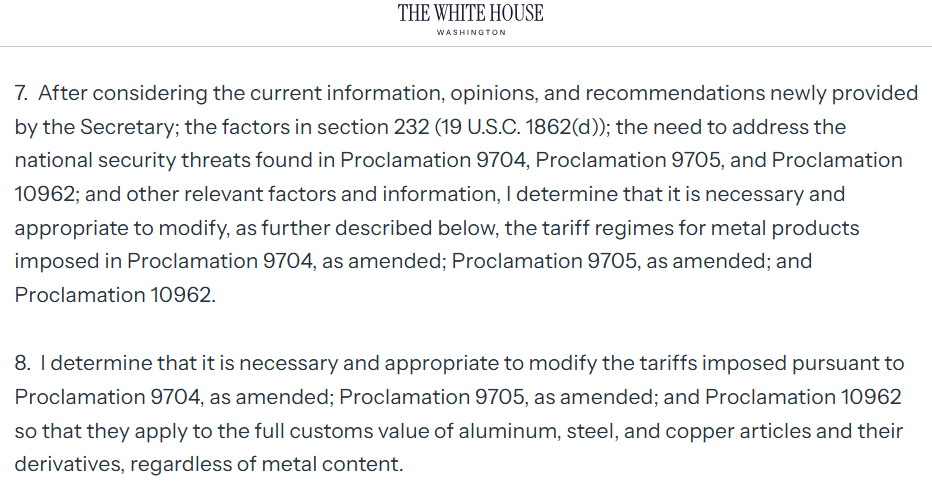
Historically, savvy importers utilized a clever accounting maneuver to minimize their tax exposure: they would separate the value of the raw metal from the value of the manufacturing labor, paying duties only on the former. This latest proclamation ends that practice by mandating that tariffs apply to the "full customs value" of the imported articles.
This is a strategic masterstroke designed to target "value-added" circumvention. By taxing the entire cost of the finished product rather than just the weight of its metal, the U.S. prevents foreign manufacturers from stripping out manufacturing costs to lower their taxable basis. As the proclamation states:
"I determine that it is necessary and appropriate to modify the tariffs... so that they apply to the full customs value of aluminum, steel, and copper articles and their derivatives, regardless of metal content."
The Race to 80% (A Tale of Two Metals)
The administration’s "national security" benchmark is a sustained 80% domestic capacity utilization—the level deemed necessary for a self-sufficient defense industrial base. The data reveals a fascinating disparity in progress. Steel has emerged as the success story of the Section 232 era, climbing from 72.3% in 2017 to a robust 77.2% today, nearly touching the finish line.
Aluminum, however, remains the significant national security challenge. While it has risen from a dismal 39% in 2017 to 50.4% at present, it remains far below the 80% threshold. This explains the aggressive "full value" shift; the government is applying more pressure specifically where the domestic recovery has been slowest, signaling that the "Iron Curtain" is tightening precisely because the aluminum industry requires more fortification.
The "Melt and Pour" Incentive Hierarchy
The proclamation establishes a sophisticated tiered system that rewards supply chain purity. However, the technical nuance here is vital for industry stakeholders: the U.S. distinguishes between metallurgical processes based on the material. For steel, the standard is "melted and poured," while for aluminum and copper, it is "smelted and cast."
The duty rates are split across two categories:
- Annex I-A (Most Steel and Aluminum): These carry a base rate of 50%. Products from the United Kingdom receive a reduced rate of 25%, contingent on those "ongoing discussions" that frame the UK as a primary strategic partner.
- Annex I-B (Copper and select derivatives): Copper’s inclusion is a more recent development (dating back to Proclamation 10962), and these items generally carry a 25% base rate, with a 15% rate for the UK.
The "gold standard" across both annexes is a 10% duty rate. This is reserved exclusively for derivative articles where the metal content was entirely melted and poured (steel) or smelted and cast (aluminum/copper) within the United States. It is a powerful economic nudge to keep every stage of the heat-intensive manufacturing process on American soil.
The Russia "Wall" and the Purity Test
While the U.S. is negotiating reduced rates with partners like the UK, the barrier against Russian material remains an absolute "no-go" zone. The proclamation maintains a massive 200% ad valorem rate on any aluminum article or derivative that is a product of Russia.
More significantly, this 200% rate applies if any amount of primary aluminum used in the article was smelted in Russia or cast in Russia. This creates a rigorous "purity test" for global supply chains. For an American importer, even a trace amount of Russian smelting in a third-country manufacturing process now renders the entire shipment economically toxic, effectively purging Russian metal from the U.S. defense ecosystem.
Rolling Scope and the "Canned Goods" Clause
Perhaps the most agile feature of this proclamation is the termination of old, slow inclusion processes in favor of a "rolling scope." The Secretary of Commerce and the United States Trade Representative (USTR) now hold joint authority to add new derivative articles to the tariff list at a moment's notice. This allows the executive branch to bypass traditional legislative delays and react in real-time to market shifts.
A notable example of this agility is the new "Container Clause." The proclamation specifically allows for metal containers to be taxed even if they are imported while filled with unrelated, non-tariffed goods. This effectively closes the "canned goods" loophole, preventing companies from using the contents of a container as a Trojan horse to bring in high-value steel or aluminum packaging without paying the national security duty.
This proclamation marks the definitive transition of Section 232 from a static tax into a dynamic industrial tool. By focusing on full customs value and the specific geography of the "melt," the U.S. is not just taxing imports; it is architecting a domestic manufacturing renaissance through trade law.
As we move forward, we must ask: Is this the blueprint for a new global standard of protectionism, or a temporary measure that will relax once the 80% capacity goal is hit? For now, the administration has made its choice clear—the security of the American forge is no longer up for negotiation.
03 Apr, 2026