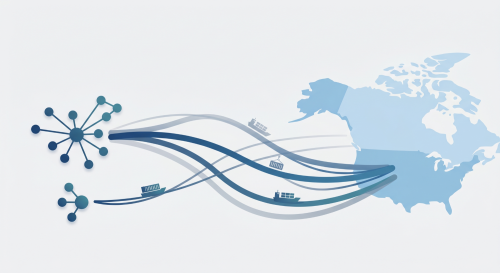
On May 4, 2026, Amazon made a defining move that will permanently reshape global shipping: it officially launched Amazon Supply Chain Services (ASCS), opening its massive logistics infrastructure to businesses of all types and sizes. The e-commerce giant is stepping far beyond its own marketplace, offering freight, distribution, fulfillment, and parcel shipping to industries spanning healthcare, manufacturing, and general retail.
By effectively turning its internal supply chain into a commercially available platform, Amazon is positioning itself as a direct competitor to traditional logistics titans like UPS, FedEx, DHL, and specialized third-party logistics (3PL) providers.
For cross-border brands and independent retailers, this raises an urgent question: Should you hand the keys to your entire supply chain over to the world's most powerful retailer?
The Appeal of the Amazon Machine
For a long time, Amazon's fulfillment network was the walled garden that gave its marketplace sellers a distinct advantage. Now, any business can plug into that same grid.
The value proposition relies heavily on sheer scale and aggressive pricing:
- Amazon claims its transportation costs are up to 25% lower than alternative logistics providers.
- The service leverages proprietary AI forecasting models and a massive domestic fleet—including roughly 80,000 trailers—to automate inventory movement.
- Major global conglomerates, including Procter & Gamble, 3M, and Lands' End, have already signed on to route their inventory through Amazon's expanded network.
The Hidden Risks of Total Supply Chain Surrender
While outsourcing your end-to-end logistics to Amazon might seem like an easy button, it presents severe strategic vulnerabilities for mid-market and independent brands.
1. Data Dominance and Conflict of Interest
Amazon is not just a logistics carrier; it is the ultimate retail competitor. By utilizing ASCS for your direct-to-consumer (DTC) or wholesale channels, you are actively feeding your upstream supply chain data—including manufacturing timelines, raw material origins, and comprehensive inventory velocity—directly into Amazon's ecosystem.
2. The "Black Box" of Algorithmic Routing
Amazon's network thrives on rigid uniformity. Your cargo is fed into an algorithm optimized for Amazon's overall network efficiency, not your brand's unique needs. If your shipments face sudden origin port congestion or you need to urgently pivot your customs clearance strategy due to shifting tariff regulations, you are locked into the automated flow of the machine. True supply chain agility disappears.
3. The Absence of Origin Quality Control
Amazon ASCS is designed to move boxes rapidly from point A to point B. It does not inspect what is inside those boxes. For cross-border brands sourcing from Asia, shipping defective units across the ocean is a fatal financial error. By the time Amazon's highly efficient system delivers a faulty product to your customer, the damage to your brand equity—and the exorbitant cost of reverse logistics—is already done.
Scaling across Walmart, Shopify, and alternative marketplaces is impossible without a resilient international supply chain. You need a logistics partner capable of executing flawless transpacific freight forwarding to feed your North American 3PLs and distribution centers.
We specialize in high-efficiency ocean and air freight routing from China to the U.S. and Canada, ensuring your inventory arrives on time, every time. As your manufacturing footprint evolves, we also provide direct, integrated shipping solutions from Vietnam to the U.S. Build your multichannel empire on a logistics network designed for uninterrupted global commerce.
06 May, 2026